

Cycle Counting vs Annual Stocktakes: Which Inventory Counting Method Is Best?
25 Sep 2026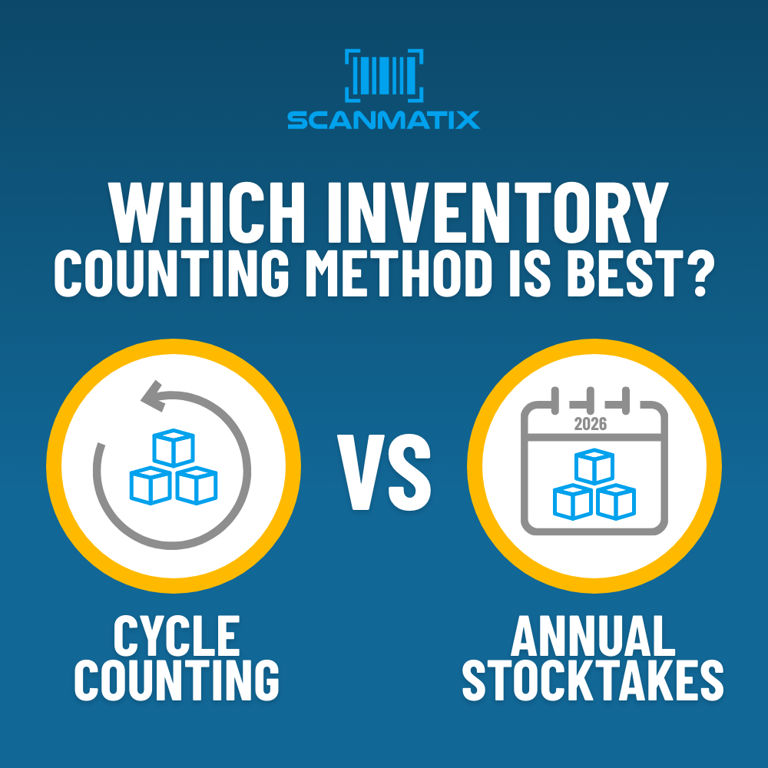
Knowing exactly what stock you have is fundamental to effective inventory management.
But how often should you physically verify it?
For many businesses, inventory counting traditionally means carrying out a large stocktake at a particular point in the year. Other organisations use cycle counting, where smaller sections of inventory are counted regularly throughout the year.
Both approaches have their place.
The right method depends on factors including the size and complexity of your inventory operation, how frequently stock moves and how you use inventory data within the business.
Understanding the difference between cycle counting and full stocktakes can help you determine which approach is best suited to your operation.
What Is a Full Stocktake?
A full stocktake involves physically counting the inventory within a defined location or operation.
The physical count can then be compared with the inventory records held within the business's systems.
This provides an opportunity to identify discrepancies between recorded and physical stock.
Many organisations conduct a full stocktake periodically, often as part of an established annual or scheduled inventory process.
For businesses with large warehouses or substantial quantities of stock, however, a full count can represent a significant operational exercise.
It requires planning, people, appropriate data capture processes and a clear method for reviewing the results.
What Is Cycle Counting?
Cycle counting takes a different approach.
Rather than counting the entire inventory at the same time, smaller groups or sections of stock are counted on a recurring basis.
Over time, inventory is therefore checked through a series of smaller counts rather than relying exclusively on one large stocktaking exercise.
For example, a warehouse could count different inventory locations, product groups or other defined sections at different stages throughout its operating calendar.
This creates opportunities to verify inventory records more regularly.
Cycle Counting vs Full Stocktakes: What's the Difference?
The fundamental difference is the frequency and scope of the count.
A full stocktake aims to establish the physical inventory position across the relevant operation at a particular point in time.
Cycle counting divides that process into smaller, recurring counting exercises.
Neither approach automatically guarantees accurate inventory.
Accuracy still depends on how the count is planned, captured, controlled and reconciled.
However, the two methods can have very different implications for day-to-day operations.
Advantages of Full Stocktakes
A Comprehensive Inventory Check
A full stocktake provides a broad physical check of the inventory within the scope of the count.
Rather than examining individual sections at different times, the business can establish a physical inventory position across the operation.
Clear Reconciliation Point
A scheduled full count provides a defined point at which physical inventory can be compared with system records.
Discrepancies can then be identified and investigated.
Suitable for Periodic Verification
For some businesses, a periodic full stocktake may suit their operating model better than establishing an ongoing cycle-counting programme.
This could be influenced by stock volumes, operational patterns, resources and the way inventory is managed.
Challenges of Full Stocktakes
Operational Disruption
Counting an entire warehouse or large inventory holding can require considerable coordination.
Businesses need to consider how inventory movements will be managed while the count takes place and how normal operations will interact with the stocktake.
Resource Requirements
Large stocktakes can require significant employee time.
Businesses need people to perform counts, supervise the process, investigate discrepancies and reconcile the resulting information.
For organisations without the internal resources or technology to carry out an efficient stocktake, outsourcing can also provide an alternative.
Scanmatix offers stocktaking as a service, combining its inventory technology with experienced stocktaking teams.
Large Volumes of Data
A full stocktake can generate a substantial quantity of information in a relatively short period.
Effective mobile data capture and reporting are therefore important for managing the resulting data and investigating discrepancies efficiently.
Advantages of Cycle Counting
More Frequent Inventory Verification
Cycle counting allows businesses to check parts of their inventory throughout the year.
Instead of waiting for the next major stocktake to physically verify particular stock, inventory can be reviewed according to the organisation's counting programme.
Smaller Counting Exercises
Breaking inventory into smaller counts can make individual counting exercises more manageable.
Rather than mobilising resources to count everything at once, businesses can incorporate smaller counts into their inventory-control processes.
Earlier Identification of Discrepancies
More frequent counting can provide opportunities to identify discrepancies sooner.
This can be particularly useful because a discrepancy is not simply a number that needs to be corrected.
It can be evidence of a wider process issue.
Investigating why recorded and physical stock differ can help businesses identify areas of their inventory process that require attention.
Support for Ongoing Inventory Control
Cycle counting changes physical inventory verification from an occasional event into a more regular stock-control activity.
For businesses with frequent inventory movements, this can support a more continuous approach to inventory accuracy.
Challenges of Cycle Counting
Cycle counting also requires discipline.
A business needs a defined process determining what is counted, when it is counted and how discrepancies are handled.
If counts are performed inconsistently or results are not properly investigated, simply counting more frequently will not solve inventory-control problems.
The data capture process also needs to be efficient.
If every cycle count involves substantial paperwork or manual data entry, the administrative workload can reduce the benefit of conducting smaller, more frequent counts.
Do You Have to Choose One or the Other?
Not necessarily.
Cycle counting and full stocktakes can form part of the same inventory-control strategy.
A business could conduct rolling counts throughout the year while also carrying out a wider physical stocktake when required.
The appropriate combination depends on the organisation.
The important point is that inventory counting should not be treated purely as an exercise in producing a final number.
The information generated should help the business understand the accuracy of its inventory records and identify the reasons behind discrepancies.
How Mobile Data Capture Improves Inventory Counting
Whether you use cycle counts, full stocktakes or a combination of both, the method used to capture inventory data matters.
Paper-based counts can create additional stages between physically checking an item and updating the digital inventory record.
Barcode scanning and mobile data capture can streamline this process.
Scanmatix provides mobile inventory capabilities designed to support accurate data collection during stocktaking and wider inventory processes.
This can help businesses capture information more efficiently and make count data available for review and reporting.
Reporting Is as Important as Counting
Finishing the physical count is only one part of the stocktaking process.
Businesses also need to understand the results:
- Where are the discrepancies?
- Which products or locations require investigation?
- What does the physical count show compared with the expected inventory position?
Reporting provides the bridge between counting stock and acting on the information generated.
Scanmatix provides detailed inventory reporting capabilities that allow businesses to examine stock information and drill down into the underlying data.
This supports a more analytical approach to inventory control rather than simply treating a stocktake as a periodic administrative task.
Which Inventory Counting Method Is Best for Your Business?
There is no single counting method that will suit every organisation.
A full stocktake may be appropriate where a business needs a comprehensive physical inventory check at defined intervals.
Cycle counting may be more appropriate where an organisation wants to verify smaller sections of inventory more frequently.
For some businesses, combining both methods may provide the most practical approach.
When evaluating the options, consider:
- The size and complexity of your inventory
- The number of warehouses or stock locations
- How frequently inventory moves
- The resources available for counting
- The level of operational disruption a full count could create
- How quickly discrepancies need to be identified
- How inventory data is captured and reported
- Whether your existing inventory systems support the required processes
The objective should be to establish a counting process that provides reliable information without introducing unnecessary complexity into the operation.
Make Inventory Counting Work Harder for Your Business
Stocktaking should provide more than a physical count.
With the right mobile data capture, inventory management and reporting processes, stocktakes and cycle counts can provide valuable information about the accuracy and effectiveness of your wider inventory operation.
Scanmatix supports full stocktakes and rolling cycle counts, combining mobile data capture with inventory management and detailed reporting.
For businesses that want additional support, Scanmatix also provides professional stocktaking services using its own platform and inventory specialists.
Speak to the Scanmatix team to find the right approach for your stocktaking and inventory management requirements.
UK: 0330 004 0630
IRL: 01 554 7359
Email: info@scanmatix.com


